Double Tax Treaties in Luxembourg
Overview of Luxembourg's double tax treaties, including those with the UAE, Germany, the UK and the USA, and how they help avoid double taxation. Ask us.
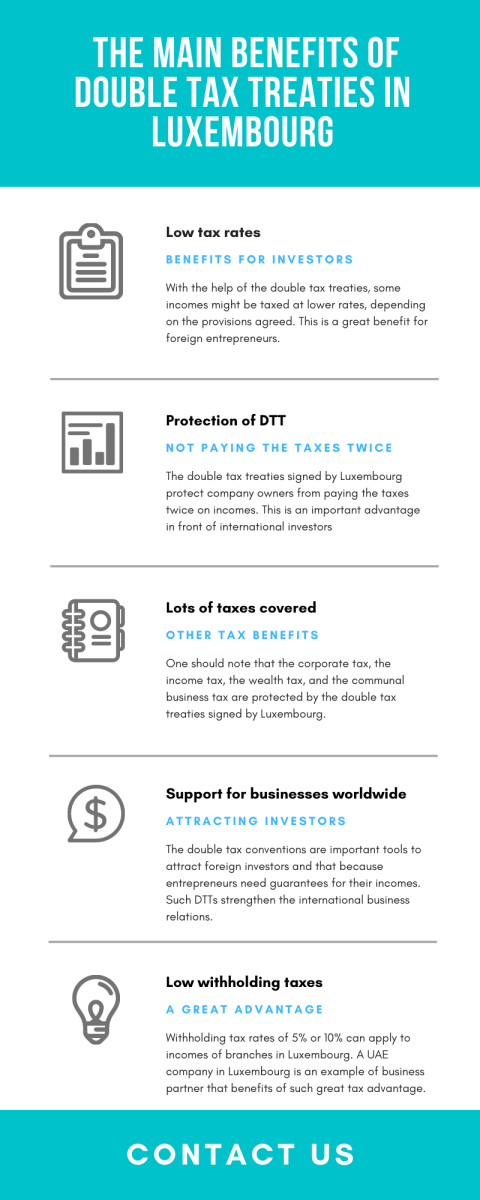
Luxembourg has concluded 88 double tax treaties as of July 2026 and 6 more are signed, but not yet in force. A convention for the avoidance of double taxation is advantageous for foreign investors who want to open a business in Luxembourg. One of our specialists in Luxembourg can provide support and guidance to entrepreneurs from abroad who want to benefit of the double taxation avoidance.
What are the provisions of a double tax treaty?
The most important goal of a double taxation treaty is to eliminate double taxation for the same individual or same legal entity. This implies that the contracting states decide which of them will levy a certain tax on the income produced therein.
The withholding taxes on dividends, interest and royalties, as well as the taxation of capital gains, are covered by double tax treaties. While both countries impose a normal rate for these types of income, under an agreement of this type, the rate will be reduced and, in some cases, will be even eliminated completely.
The types of taxes usually covered by a double tax treaty include: the corporate tax, the income tax, the wealth tax, the communal business tax and others.
Special provisions within these treaties allow for the prevention of tax discrimination and also for the prevention of tax evasion. Special rules are in place for the exchange of information between the contracting states.
What are the countries Luxembourg signed treaties with?
Luxembourg has signed double tax treaties with the following countries: Albania, Andorra, Armenia, Austria, Azerbaijan, Bahrain, Barbados, Belgium, Botswana, Brazil, Brunei, Bulgaria, Canada, China, Croatia, Cyprus, the Czech Republic, Denmark, Estonia, Ethiopia, Finland, France, Georgia, Germany, Greece, Guernsey, Hong Kong, Hungary, Iceland, India, Indonesia, Ireland, Isle of Man, Israel, Italy, Japan, Jersey, Kazakhstan, Kosovo, Laos, Latvia, Liechtenstein, Lithuania, North Macedonia, Malaysia, Malta, Mauritius, Mexico, Moldova, Monaco, Montenegro, Morocco, the Netherlands, Norway, Panama, Poland, Portugal, Qatar, Romania, Russia (This country suspended the main provisions of the treaty since 8 August 2023), Rwanda, San Marino, Saudi Arabia, Senegal, Serbia, Seychelles, Singapore, Slovakia, Slovenia, South Africa, South Korea, Spain, Sri Lanka, Sweden, Switzerland, Taiwan, Tajikistan, Thailand, Trinidad & Tobago, Tunisia, Turkey, Ukraine, United Kingdom, United Arab Emirates, USA, Uruguay, Uzbekistan and Vietnam.
Treaties signed, but not yet in force are concluded with: Argentina, Cabo Verde, Colombia, Ghana, Kuwait and Oman; Kyrgyzstan is initialled only, and Chile, Egypt, Mali, New Zealand and Pakistan are under negotiation.
Protocols amending the treaties with Georgia, San Marino and Vietnam were signed in 2023–2025 and approved, but they are not yet applicable.
What are the main tax rates in Luxembourg?
Luxembourg is an appealing business hub that offers great conditions in terms of taxation to international investors.
For instance, since 2025, companies with less than EUR 175,000 taxable income,pay corporate income tax of 14%. Companies with taxable incomes between EUR 175,000 and 200,000 must pay EUR 24,500 and 30% of the tax base above EUR 175,000, and companies with taxable income above EUR 200,000 pay 16%. The government has announced a further decrease of the corporate income tax from 2027.
The solidarity surtax of a 7% rate is levied on the corporate income tax of all companies (17.12% in total for the 16% rate).
The municipal business tax of 6.75% is applicable in Luxembourg City, but it varies in each municipality, so the combined rate in Luxembourg City is 23.87%.
When it comes to VAT, this is one of the lowest among the European countries and it is established at a 17% rate for most taxable goods and services. A reduced VAT tax of 14% applies to: mineral oils, printed advertising materials, credit administration and more. As for the 8% VAT rate, this is applicable to: gas and electricity, firewood, hairdressing and minor repairs of clothing, shoes and leather goods, among others. The VAT rate of 3% applies to: foodstuff, pharmaceutical products, books, restaurant services (excluding alcohol), children’s clothing and footwear, etc.
What are laws regulating double tax treaties in Luxembourg?
There is a law approving each double tax treaty signed by Luxembourg with other countries. Where there is no treaty, the main domestic act is the amended Law of 4 December 1967 on income tax, which contain the main provisions about: rules on tax residence, the exemption of foreign income and the credit for foreign taxes, general tax law and the law on net wealth tax.
What are the main problems faced by foreign investors when using Luxembourg’s double tax treaties?
- •Proving tax residence: It is difficult for companies with little substance in Luxembourg to obtain a certificate of tax residence required in order to benefit of the tax treaty;
- •Anti-abuse rules: tax authorities can legally refuse treaty benefits to holding structures without real economic activity;
- •Slow refunds: obtaining a refund in case the reduced treaty rate is not applied at source can take some time.
- •Treaties not yet in force or suspended: the investors must wait for some treaties to enter into force, such as those with: Argentina, Cabo Verde, Colombia, Ghana, Kuwait, Oman. There is also the treaty with Russia that is suspended.
How can your specialists help foreign investors benefit from Luxembourg’s double tax treaties?
Our team in Luxembourg helps foreign investors take advantage of the double tax treaties by:
- •Structuring: we check which treaty applies and choose the right structure for your business with enough substance in Luxembourg.
- •Certificates and forms: we request tax residence certificates from the Direct Tax Administration and prepare the forms needed to apply reduced withholding tax rates at source or to claim refunds abroad.
- •Compliance: we prepare the corporate tax returns, apply the participation exemption, document the commercial reasons of the structure and monitor changes in the treaty network.
- •Disputes: we assist clients in discussions with the tax authorities and in mutual agreement procedures when the same income is taxed in both countries.
We have a dedicated team of advisors with experience in taxation who can also tell you more about any double tax treaty in Luxembourg. Contact us for details about our services.
Daniel Milano, Managing Director, Sigtax Luxembourg SA · 18 November 2026